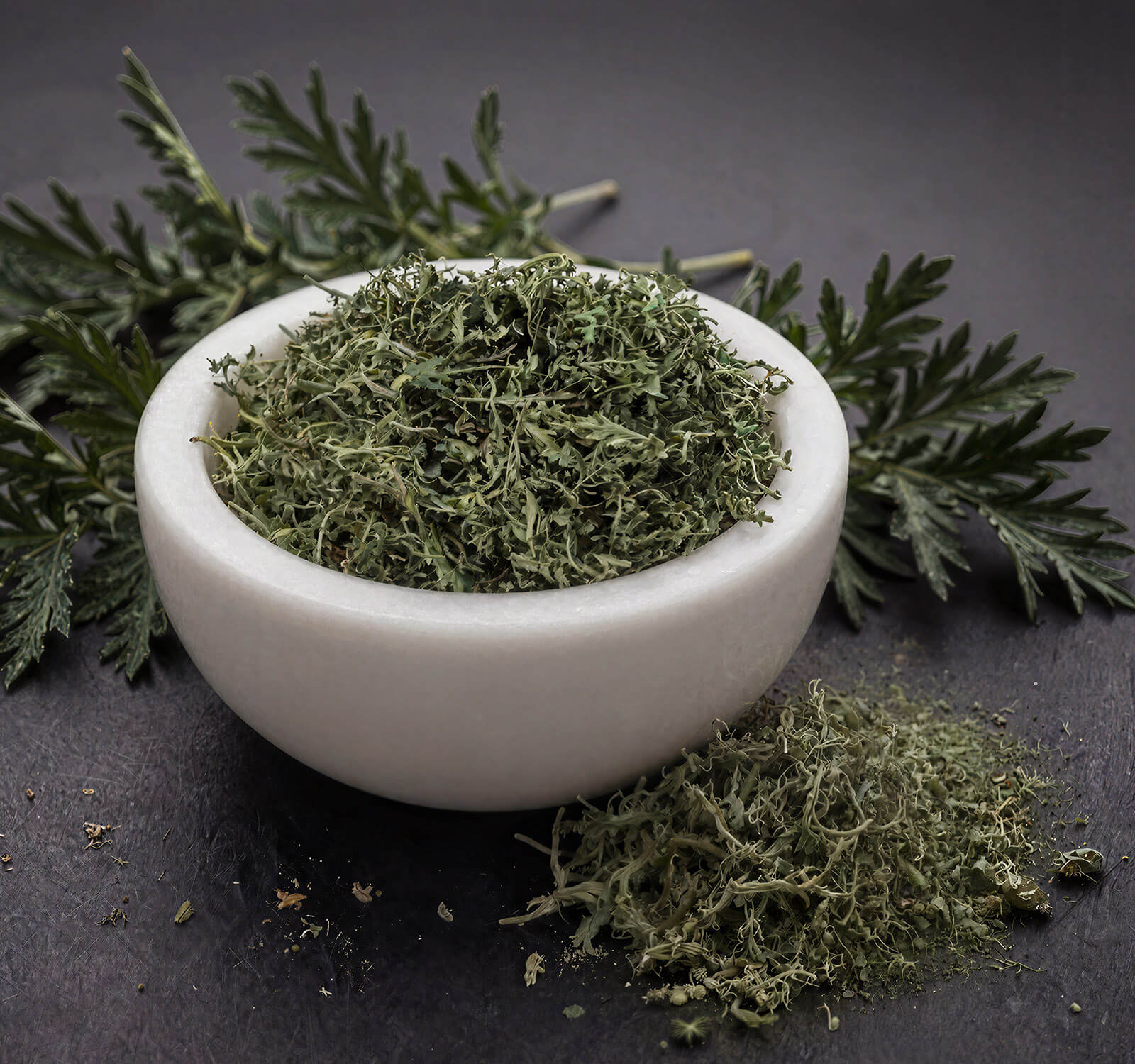
This article presents the state of research in the fight against leishmaniasis, Chagas disease and trypanosomiasis with the Artemisia annua plant.
Artemisia annua as a plant in the fight against parasitic infections
Artemisia annua has been known for centuries in traditional Chinese medicine in the fight against malaria, particularly thanks to its main active ingredient, the artemisinin molecule. As it is considered a promising means in the fight against parasitic diseases, many researchers have studied this plant with the aim of treating other parasitic diseases.
Among these diseases, three have aroused the curiosity of researchers: leishmaniasis, Chagas disease and African trypanosomiasis (also called sleeping sickness). These diseases are all caused by the presence of parasites that mainly affect poor populations in tropical and subtropical areas. Current treatments, either very costly or toxic, are proving increasingly ineffective, which is why research has taken an interest in the use of Artemisia annua to fight these diseases.
The origins of these three conditions
Leishmaniasis: this disease is transmitted by the sandfly, a small midge that bites its victims and transmits the parasite to them. The bite can cause sores on the skin and, in the most serious cases, can reach internal organs, particularly the liver and spleen.
Chagas disease: this disease is transmitted by a bug called Reduviidae, very widespread in Latin America. The parasite transmitted by this insect can live in its host without showing itself for years. When the parasite becomes active, it can cause damage to the heart and digestive system.
Trypanosomiasis: this disease is transmitted by the famous tsetse fly, which transmits the parasite by biting its victims. The parasite then attacks the victim’s nervous system and can be fatal without rapid treatment.
The state of research against leishmaniasis: encouraging studies
Research carried out in vitro and on animals has found that Artemisia annua and its extracts had the effect of slowing the progression of parasites and also made it possible to kill them.
A recent study used a preparation based on artemisinin, the main active ingredient of Artemisia annua, which was enclosed in fat capsules to allow the molecule to act in the right place, that is, to reach infected cells. This study conducted on mice made it possible to stop the progression of the disease, and the preparation showed no signs of toxicity for the liver and kidneys.
Another study used essential oil extracted from Artemisia annua leaves and found that this preparation was capable of killing the parasite responsible for the disease by activating a form of self-destruction of the parasitic cells.
The state of research against trypanosomiasis: positive signs
In vitro studies have shown that extracts of Artemisia annua were capable of killing the parasite responsible for sleeping sickness, even at relatively low doses. An even stronger activity against the parasite was observed for modified derivatives of artemisinin. These results unfortunately lack confirmation by studies conducted on human subjects but raise hopes for treatment.
The state of research against Chagas disease: mixed results
The picture concerning research on Chagas disease is unfortunately not as clear. Indeed, several studies contradict each other on the effects that artemisinin can have on the parasite of the disease. Some studies find positive effects for the treatment of the disease, while others observe no significant effect.
These differences can be explained by differences in the research methods used, the parasite strains tested or the form of the medication.
Additional research is therefore necessary to know the potential of the plant in the fight against Chagas disease. To date, these contradictory studies do not allow us to affirm with certainty that Artemisia annua is effective in treating Chagas disease.
The mode of action of artemisinin
The main active ingredient of Artemisia annua, artemisinin, owes its effectiveness to its unique chemical structure. The molecule becomes strongly activated in the presence of iron-rich body cells. The action of the artemisinin molecule causes the formation of toxic compounds that end up damaging the parasite from the inside thanks to a chain reaction. This mechanism was also observed when the molecule acted against the parasite that causes malaria.
The use by researchers of nanoparticles in treatment research against these diseases aims to improve the effectiveness of the artemisinin molecule. The objective is to use these nanoparticles as “carriers” that will protect the preparation until it reaches the infected cells. In this way, researchers attempt both to increase the effectiveness of treatments and to reduce side effects.
In summary
- Artemisia annua and its main active ingredient, artemisinin, show promising effects against the parasitic diseases leishmaniasis and trypanosomiasis in in vitro and animal studies.
- The fight against Chagas disease using this plant presents uncertain research that requires additional studies.
- Research has not yet moved to the stage of human subjects and requires funding that is lacking.
Artemisia annua could become an additional plant whose extracts would make it possible to fight these parasitic diseases that attract little attention given the regions affected, that is, poor regions. However, current research can only arouse interest in more in-depth research to discover all its potential, in the hope of offering safer and cheaper treatments for the affected populations.
Notes &
references
-
Bilia AR, Kaiser M, Tasdemir D. Antitrypanosomal and antileishmanial activities of organic and aqueous extracts of Artemisia annua. Planta Med. 2009;75:PD34.
-
Want MY, Islamuddin M, Chouhan G, et al. Therapeutic efficacy of artemisinin-loaded nanoparticles in experimental visceral leishmaniasis. Colloids Surf B. 2015;130:215-221.
-
Mishina YV, Krishna S, Haynes RK, Meade JC. Artemisinins inhibit Trypanosoma cruzi and Trypanosoma brucei rhodesiense in vitro growth. Antimicrob Agents Chemother. 2007;51(5):1852-1854.
-
Machín L, Nápoles R, Gille L, Monzote L. Leishmania amazonensis response to artemisinin and derivatives. Parasitol Int. 2021;80:102218.
-
Machín L, et al. In vitro and in vivo activity of a lipid-based artemisinin formulation against Leishmania (Leishmania) amazonensis. Exp Parasitol. 2025;278:109032.
-
Sen R, Ganguly S, Saha P, Chatterjee M. Efficacy of artemisinin in experimental visceral leishmaniasis. Int J Antimicrob Agents. 2010;36(1):43-49.
-
Loo CS, Lam NS, Yu D, et al. Artemisinin and its derivatives in treating protozoan infections beyond malaria. Pharmacol Res. 2017;117:192-217.
-
Islamuddin M, Chouhan G, Want MY, et al. Leishmanicidal activities of Artemisia annua leaf essential oil against visceral leishmaniasis. Front Microbiol. 2014;5:626.
-
da Gama Bitencourt JJ, et al. A novel outlook in the delivery of artemisinin: production and efficacy in experimental visceral leishmaniasis. Pharm Dev Technol. 2023;28(3):221-234.
-
Expanding the scope of synthetic 1,2,4-trioxanes towards Trypanosoma cruzi and Leishmania donovani. Bioorg Med Chem Lett. 2020;30(18):127412.