Origins and first written traces
The oldest mention of the plant dates back to 168 BCE, found in a work written on a piece of silk: the Wu Shi Er Bing Fang (Prescriptions for Fifty-Two Ailments). Discovered at Mawangdui, an exceptional archaeological site in Hunan Province, this work recommends the use of Qing Hao (Artemisia annua) for hemorrhoids.
The first mention of Artemisia annua for treating fever is found in the Shen Nong Ben Cao Jing (The Divine Farmer’s Materia Medica), the foundational text of Chinese medicine. The work indicates that the plant can be used to “relieve heat lodged in the joints,” referring to febrile conditions.
As early as the 3rd century, the Chinese physician Zhang Ji (150–219) recommended using Qing Hao to treat fevers, sweats, or jaundice in his treatise Shang Han Lun (Treatise on Cold Damage Disorders).
Then, in the 4th century, the Zhouhou Beiji Fang (Emergency Formulas to Keep Up One’s Sleeve) by the scholar Ge Hong (283–343) presents a precise description of an extraction method. Qing Hao must be extracted cold by macerating leaves in water to extract the juice. This juice is then consumed to relieve and treat fevers. This preparation method later became a source of inspiration for artemisinin research.
Evolution of use in Chinese medicine
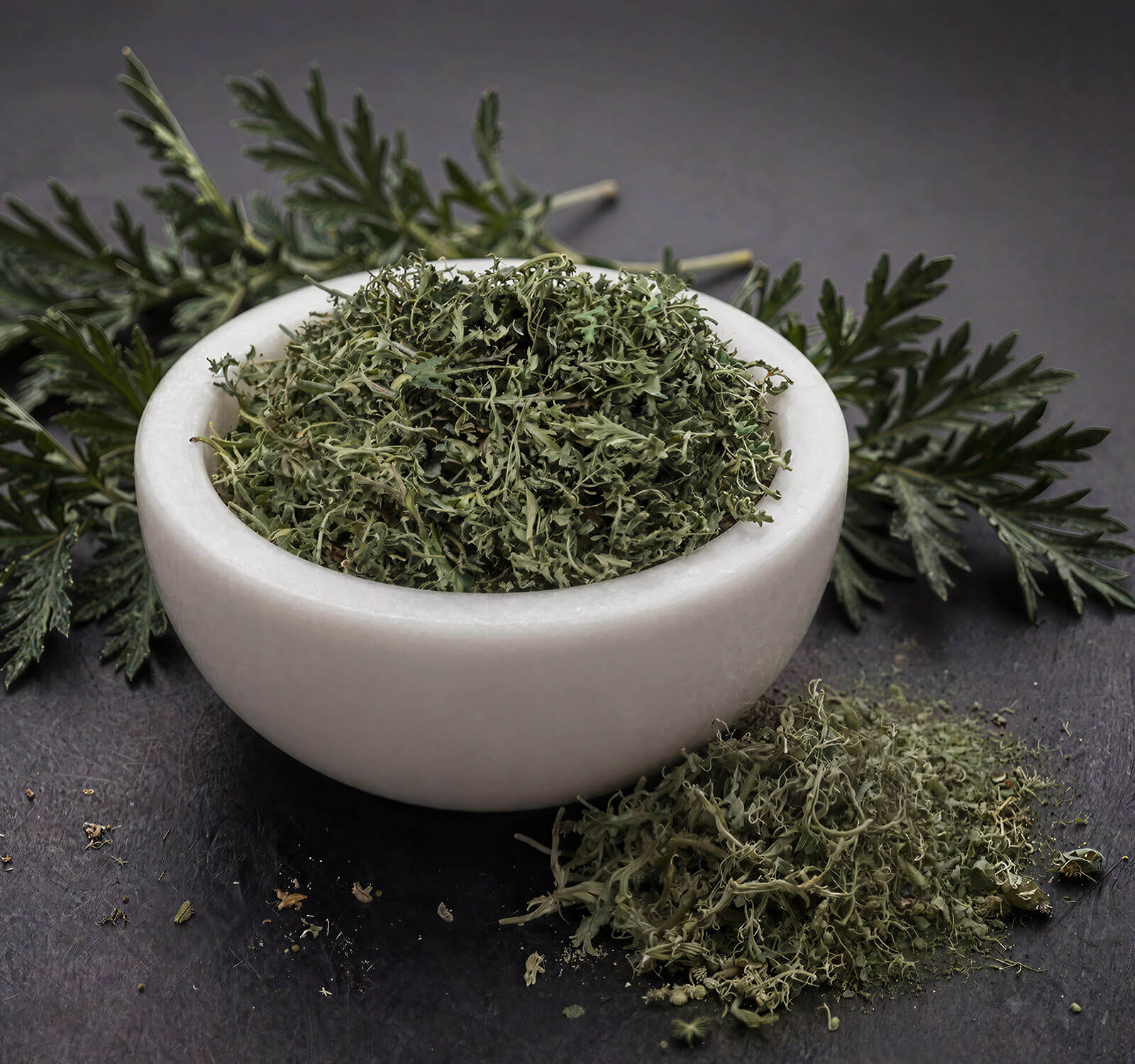
Medical texts from the Song (960–1279), Yuan (1271–1368), and Ming (1368–1644) dynasties recommend using the plant in the form of decoctions, pills, or powder. The texts sometimes indicate the use of other herbs or plants in combination with Qing Hao to treat fevers and malarial paroxysms (typical manifestations of malaria: chills, heat, sweats).
The Ben Cao Gang Mu (Compendium of Materia Medica), written in 1596 by Li Shizhen, a naturalist physician, describes the use of the plant for treating the paroxysmal (i.e., sudden and repeated) fever of malaria. This work solidified the position of Artemisia annua in its traditional use against febrile conditions.
Mentions of fumigating the plant to repel harmful insects, particularly mosquitoes (the main vectors of malaria), are also present in various treatises.
Main traditional uses
The main traditional uses from the texts of traditional Chinese medicine are as follows:
-
Treatment of fevers (including those of malaria)
-
Relief of inflammation and jaundice
-
Use as a tonic, antiparasitic agent, and immune system booster
The different methods of preparation include infusions, cold decoctions, pills, powders, and fumigations.
Modern discovery and scientific recognition
It was by drawing inspiration from Ge Hong’s text that Tu Youyou, a Chinese researcher, discovered the artemisinin molecule present in Artemisia annua. In the 1970s, she succeeded in isolating the plant’s major active compound, which is now used worldwide to combat malaria.
Her discovery earned her the Nobel Prize in Medicine in 2015. This prize recognized both her research and the invaluable contribution of traditional Chinese medicine in the fight against viral and infectious diseases.
Conclusion
The use of Artemisia annua, or Qing Hao, dates back several millennia. Mentioned in numerous traditional Chinese medicine treatises, it has been primarily used to treat fevers. This rich history led to its rediscovery in the 20th century and enabled the isolation of its most promising active compound, artemisinin. This molecule will continue to make headlines, as research for the treatment of other conditions, particularly cancers, is constantly developing. In any case, this plant has demonstrated the invaluable value of Chinese medicine in its contribution to human health worldwide.
Notes &
references
- ACADÉMIE NATIONALE DE MÉDECINE, « Accès palustre » in Dictionnaire de l’Académie de médecine – version 2020. [En ligne] https://www.academie-medecine.fr/le-dictionnaire/index.php?q=acc%C3%A8s+palustre (Consulté le 25 janvier 2026).
- DANIS, Martin, et RICHARD-LENOBLE, Dominique, « Le prix Nobel de médecine 2015 » in Médecine/Sciences, vol. 32, n° 1, janvier 2016, p. 110-111. [En ligne] https://www.medecinesciences.org/articles/medsci/full_html/2016/01/medsci20163201p110/medsci20163201p110.html (Consulté le 25 janvier 2026).
- INSERM (Institut national de la santé et de la recherche médicale), « L’Artemisia, plante miracle, vraiment ? » in Canal Détox, 2 juillet 2020. [En ligne] https://presse.inserm.fr/canal-detox/lartemisia-plante-miracle-vraiment/ (Consulté le 25 janvier 2026).
- LA MAISON DE L’ARTEMISIA, « Usages traditionnels de l’Artemisia » in maison-artemisia.org. [En ligne] https://maison-artemisia.org/usages-traditionnels/ (Consulté le 25 janvier 2026).
- LOUMÉ, Lise, « Question de la semaine : qu’est-ce que l’Artemisia et pourquoi l’OMS l’interdit-elle ? » in Sciences et Avenir, 19 septembre 2019. [En ligne] https://www.sciencesetavenir.fr/sante/question-de-la-semaine-qu-est-ce-que-l-artemisia-et-pourquoi-l-oms-l-interdit-elle_137411 (Consulté le 25 janvier 2026).
- MAZIER, Dominique, et THELLIER, Marc, « Tu Youyou et la découverte de l’artémisinine : une contribution majeure de la médecine traditionnelle chinoise à la pharmacopée moderne » in Médecine/Sciences, vol. 32, n° 1, janvier 2016, p. 106-109. [En ligne] https://www.medecinesciences.org/articles/medsci/full_html/2016/01/medsci20163201p106/medsci20163201p106.html (Consulté le 25 janvier 2026).
- MÉDIA CHIMIE, « Un prix Nobel de médecine très chimique » in mediachimie.org. [En ligne] https://www.mediachimie.org/content/un-prix-nobel-de-m%C3%A9decine-tr%C3%A8s-chimique (Consulté le 25 janvier 2026).
- ORNANO, Antoine, « Le Nobel de Youyou Tu est-il une reconnaissance de la médecine traditionnelle chinoise ? » in The Conversation, 8 octobre 2015. [En ligne] https://theconversation.com/le-nobel-de-youyou-tu-est-il-une-reconnaissance-de-la-medecine-traditionnelle-chinoise-48701 (Consulté le 25 janvier 2026).
- WIBAUX, Valérie, « Armoise chinoise : Nobel et paludisme » in Le Quotidien du Pharmacien, 23 octobre 2015. [En ligne] https://www.lequotidiendupharmacien.fr/exercice-pro/etudes-formation-continue/armoise-chinoise-nobel-et-paludisme (Consulté le 25 janvier 2026).
- WIKIPÉDIA, « Armoise annuelle (Artemisia annua) » in Wikipédia, l’encyclopédie libre. [En ligne] https://fr.wikipedia.org/wiki/Armoise_annuelle (Consulté le 25 janvier 2026).
- WIKIPÉDIA, « Ben Cao Gang Mu (Classes et ordres des plantes médicinales) » in Wikipédia, l’encyclopédie libre. [En ligne] https://fr.wikipedia.org/wiki/Bencao_gangmu (Consulté le 25 janvier 2026).
- WIKIPÉDIA, « Shang Han Lun (Traité sur les troubles liés au froid) » in Wikipédia, l’encyclopédie libre. [En ligne] https://fr.wikipedia.org/wiki/Shang_Han_Lun (Consulté le 25 janvier 2026).
- WIKIPÉDIA, « Shen Nong Ben Cao Jing (Classique de la matière médicale du Laboureur Céleste) » in Wikipédia, l’encyclopédie libre. [En ligne] https://fr.wikipedia.org/wiki/Shennong_Bencao_Jing (Consulté le 25 janvier 2026).
- WIKIPÉDIA, « Wu Shi Er Bing Fang (52 ordonnances) » in Wikipédia, l’encyclopédie libre. [En ligne] https://fr.wikipedia.org/wiki/Wushier_bingfang (Consulté le 25 janvier 2026).
- WIKIPÉDIA, « Zhouhou Beiji Fang (Formules d’urgence à garder sous la main) » in Wikipédia, l’encyclopédie libre. [En ligne] https://fr.wikipedia.org/wiki/Zhouhou_beiji_fang (Consulté le 25 janvier 2026).
- ZENITH, Sarah, « Artemisia annua – Einjähriger Beifuß » in Artemisia-shop.de. [En ligne] https://artemisia-shop.de/fr/blogs/artemisia/einjaehriger-beifuss (Consulté le 25 janvier 2026).
- GE, Hong (葛洪), Zhouhou Beiji Fang (《肘后备急方》 – Manuel des prescriptions pour les traitements d’urgence), rédigé originalement entre 283 et 343 apr. J.-C. Édition de référence : Ge Xianweng Zhouhou Beiji Fang (葛仙翁肘後備急方), in Zhengtong Daozang (《正统道藏》), 1445.
- LI, Shizhen (李时珍), Ben Cao Gang Mu (《本草纲目》 – Compendium of Materia Medica), rédigé originalement en 1596. Édition de référence : Ben Cao Gang Mu, Pékin : People’s Medical Publishing House, 1982.
- Mawangdui Han Mu Boshu Zhengli Xiaozu (马王堆汉墓帛书整理小组, éd.), Wu Shi Er Bing Fang (《五十二病方》 – Formulas for Fifty-two Diseases), rédigé originalement vers 168 av. J.-C., découvert sur un manuscrit de soie à Mawangdui (dynastie Han). Édition de référence : Wu Shi Er Bing Fang, Pékin : Wenwu chubanshe, 1979.
- Shennong Bencao Jing (《神农本草经》 – The Divine Farmer’s Materia Medica), rédigé originalement entre 206 av. J.-C. et 220 apr. J.-C. (dynastie Han). Auteur traditionnellement attribué à Shennong (神农). Édition de référence : Shennong Bencao Jing, diverses éditions modernes (notamment les compilations de Sun Xingyan, 1799).
- ZHANG, Ji (张仲景), Shang Han Lun (《伤寒论》 – Treatise on Cold Damage Disorders), rédigé originalement entre 150 et 219 apr. J.-C. Édition de référence : Shang Han Lun, Pékin : Xueyuan chubanshe, 2015.